
Locations: Libraries
Libraries are folders on your harddrive that have been analyzed by the software. Technically, they are small databases containing information about your samples. These data provide the foundation for similarity-search and many other features.
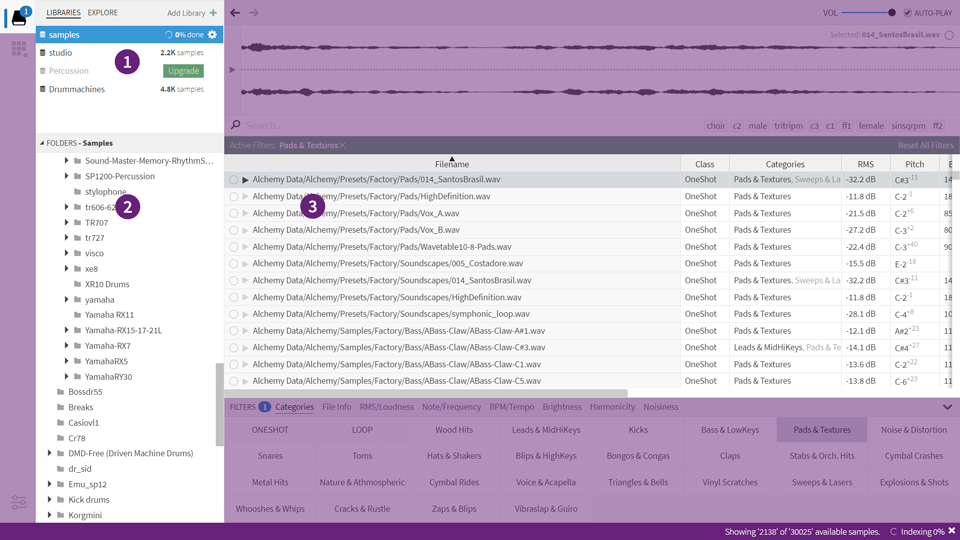
The libraries tab
- Libraries - list of libraries that are currently available
- Folder tree - displays folders for the selected library
- Search Results - a table displaying your search results
Selecting libraries
The list of active libraries appear in the topmost part of the Location sidepanel, while the “Libraries” tab is active.
To select a library, simply click it. To select more than a single library (i.e. combine libraries on-the-fly), hold Command/Ctrl pressed while selecting a library, or use the Shift modifier to “extend” the existing selection. You might notice a brief preparation time, after which the “combined” results should appear in the browser.
In the list of libraries, any library can be right-clicked to bring up it’s context menu. A special case is when multiple libraries are selected: in such a case, right-clicking within the selection will bring up a context menu that applies to all the selected libraries instead of a single one.
If you have selected multiple libraries and need to show options for a specific library within that selection, this is possible too: press the “gear” icon on the left-hand side to bring up its context-menu.
The panel also allows you to drag items around in order to re-arrange them:
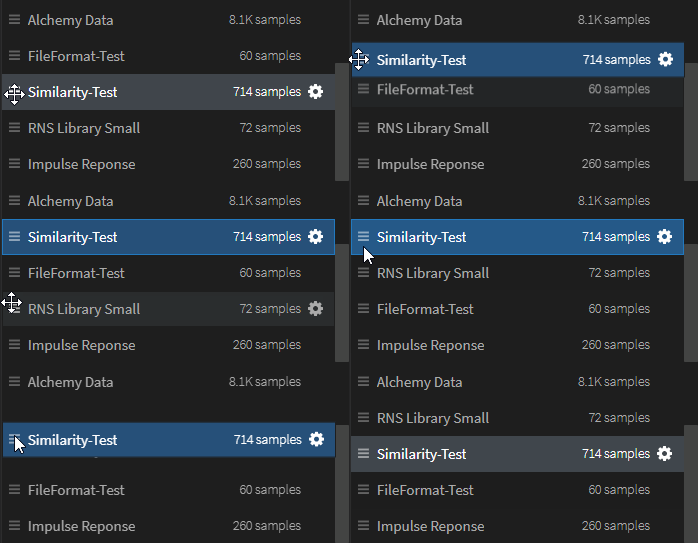
Dragging items to re-arrange
In addition to re-arranging by dragging, you can also sort libraries by name or path via the context menu.
Searching the folder tree
Press Ctrl/Cmd+F while the folder tree is focused to bring up a search field. The tree is then limited to the folders matching your search terms. Use the options button next to the search field to limit the tree to favorited folders.
Creating & Opening
If you’ve used Sononym for more than a few minutes, you will probably already have created a library.
Creating a new library is meant to be as easy as possible - you can simply drag a folder on top of the application. Alternatively, you can pick a folder using the “Add library” button, or by choosing “Create Library” from the File menu.
If the selected folder is already a library, it will immediately be added to the list of libraries. Otherwise, the application will start to index the contents and shortly, samples will begin to appear. You can track the indexing progress in the upper part of the sidepanel, as well as in the status bar.
Refreshing (Look for Changes)
Of course, your sample collections aren’t necessarily static. You might add, change or move files around at any given time. When this is the case, the Sononym library will need to be refreshed in order to pick up those changes - this will ensure that the file database is up to date.
To refresh, head into the list of libraries and right-click the library you want to refresh. Next, choose the menu entry called Refresh.
Note that refreshing a library doesn’t require all files to be re-analyzed - only new arrivals and changed files are processed.
Upgrading a library
If a library was created with an older version of Sononym than the one you’re using, the library might need to be ‘upgraded’.
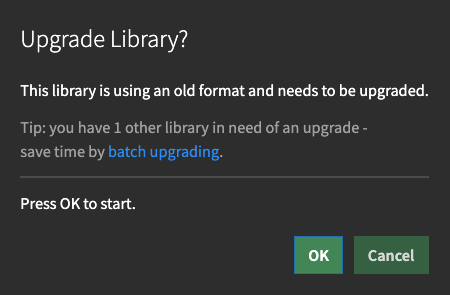
When multiple libraries are in need of upgrade, you can choose to batch upgrade them:
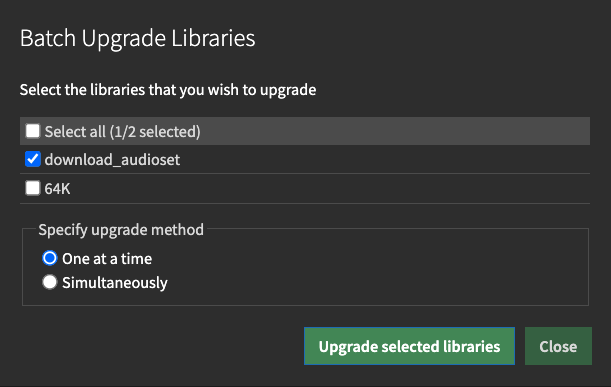
The dialog will allow you to run the upgrade process simultaneously on all libraries, or one library at a time. Upgrading one library at a time might require less computer resources.
Removing libraries
To remove a library, choose “Remove” from it’s context-menu (the library itself is located in the list of libraries). The following prompt will appear:
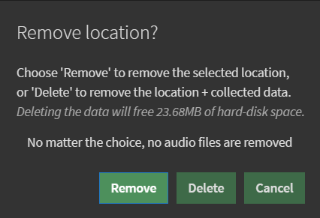
- Remove - choose this option to remove the library from the list of currently active libraries in Sononym, but leave the collected data untouched.
- Delete - choose this to remove the library from Sononym and delete all collected data.
Library Options
To view options for a given library, right-click and select it.
Refresh (Look For Changes)
Choose this to look for new/changed/deleted files. Existing information in the database is retained.
This option is also available in the context menu, and will perform the same action but for a specific subfolder only. For large libraries, this is much faster than performing a full rescan.
Rebuild (Hard Refresh)
This will perform a complete rebuild of the library. Any modifications that you have performed (e.g. changed categories) will be lost. For the same reason, this action is preceded with a warning message.
Library-specific settings, such as the analysis options, are kept when the library is rebuilt.
Library Options…
Opens the Library Options dialog for the selected library (see below).
Since Sononym 1.6.16, “Use Local Drive For Collected Data” and “Treat Location As Read-Only” have moved from the context menu into the Library Options dialog.
Library Options Dialog
Choose “Library Options…” from the context menu of a library to bring up a dialog with information about the library, and settings that apply to that library only.
The upper part of the dialog shows the name and location of the library (click the location to reveal it in Finder/Explorer), as well as the number of samples and folders it contains, and its current status.
General Options
Use Local Drive For Collected Data
Enable this option to let Sononym host the database in the application config folder.
When disabled, the application will store the information in the root folder of the sample library.
This option is practical when your samples are stored on read-only media, or if you dislike having database files (‘sononym.db’) scattered across your harddrive. Also, it might be that your media doesn’t support exclusive locking, which is a requirement for writing to the database.
Treat Location As Read-Only
When enabled, the application will not be able to perform modifications to the location.
This option is automatically enabled when read-only media was detected during initialization.
Analysis Options (Auto-Tags)
By default, a library is auto-tagged using the global settings defined in Preferences > Analysis. Uncheck Use global settings to decide, for this library only, which sources are used for auto-tagging:
- Include file name
- Include folder names
- Include metadata (artist, title and comment)
At least one source has to remain enabled.
The settings are stored inside the library itself. This means that they travel with the library (unless “Use Local Drive For Collected Data” is enabled), and that they are kept when the library is rebuilt. They can’t be changed while the library is still loading, or when the library is treated as read-only.
Changing these settings does not affect files that were already tagged. To apply the new settings to the entire library, choose “Rebuild Auto-tags (Hard Refresh)” from the Tag Options.
The same settings are also available from the Tag Options, under “Tag Analysis Options”. There, they can be applied to several selected libraries at once.
Tempo Corrections
Click Tempo Corrections… to review the files whose tempo was changed by their filename or metadata. See Tempo Corrections below.
Tempo Corrections
Automatic tempo detection is not an exact science. A detected tempo can be off by a fraction of a BPM, or by a factor: a loop at 140 BPM might be detected as 70 BPM (half tempo), or a sound with triplets as 4/3 of its actual tempo.
But very often, sample libraries already state the tempo in the file or folder name (e.g. “Kick Loop 128 BPM.wav” or “Drums_120_Am.wav”) or in the embedded metadata. Starting with Sononym 1.6.16, the detected tempo is checked against this information. When the labelling explains the detected tempo, or the length of the sound fits the labelled tempo better, the tempo is corrected.
Some rules of thumb:
- A tempo stated as such (e.g. “128 BPM”, or a tempo in the metadata) is trusted the most.
- Plain numbers (e.g. “120”) are only used when they explain the detected tempo, or when the sound lasts a whole number of bars at that tempo. Numbers below 70 or above 180 are not considered to be tempos, as they are often just indexes.
- The file name takes precedence over the metadata, which in turn takes precedence over the folder names.
- A detected tempo that is only half a BPM off is rounded to a whole BPM (e.g. 97.5 becomes 97 BPM).
- One-shots don’t keep a tempo, unless one is stated in their name or metadata.
- Sounds without a detected tempo are not given one by their labelling.
- A tempo that you have assigned yourself is never changed.
New files are corrected while they are being indexed. Libraries created with an earlier version are corrected once, in the background, after they have been loaded. You can keep using the library while this is happening.
Copying or moving files between libraries keeps their tempo, including any correction.
In the search results
In the BPM column, a corrected tempo is marked with an asterisk (*). Hover over the value to see the tempo that was originally detected. When a correction was only suggested (see below), the suggested tempo is shown next to the current one, dimmed.
To undo or apply a correction, open the BPM menu of the file (the pencil icon, or “Assign BPM” in the context menu). Its first entry offers the detected tempo (to revert) or the suggested tempo (to apply). With several files selected, choose “Revert to Detected Tempos” or “Apply Suggested Tempos” instead.
A tempo that has been reverted or applied counts as assigned by you, and will not be corrected again.
The Tempo Corrections dialog
To review all corrections in a library, choose “Library Options…” from the library’s context menu and click “Tempo Corrections…”. The overview lists two kinds of corrections:
- Corrected - the detected tempo was corrected by the labelling of the sound. These can be reverted.
- Pending - corrections that were not applied automatically, and need a manual review. These can be applied.
Click “View/Edit” to list the files of either kind:
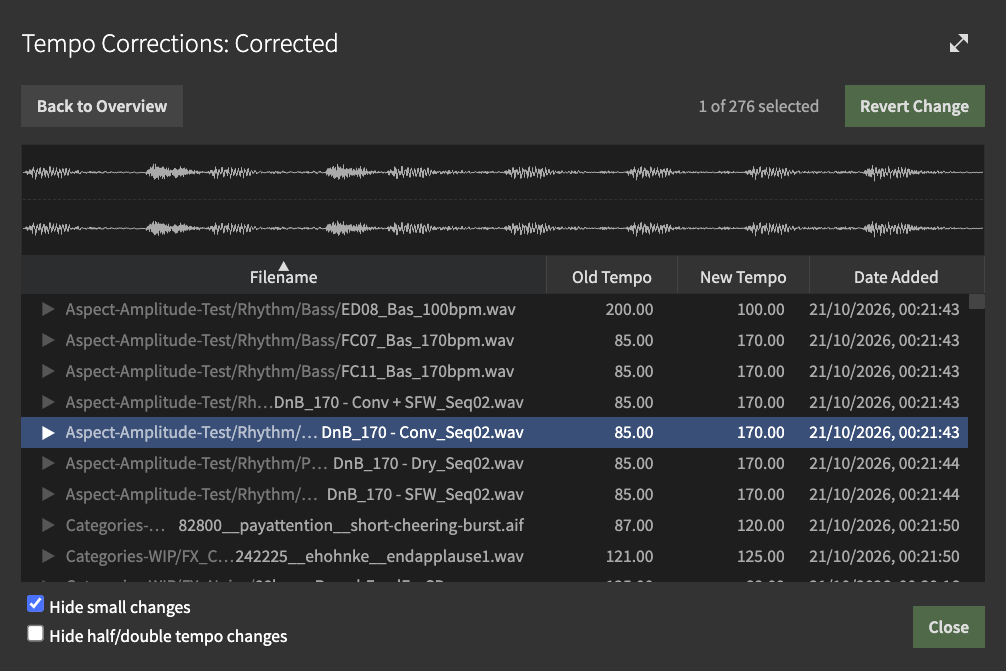
Select a file to see its waveform, press the play button to preview it, and right-click to revert or apply the change (along with the usual options, such as adding the file to a project). The columns can be sorted by clicking their headers.
Use the checkboxes at the bottom of the list to hide the corrections that are rarely worth reviewing:
- Hide small changes - corrections caused by rounding (e.g. 97.25 to 97 BPM). Enabled by default.
- Hide half/double tempo changes - corrections which halved or doubled the tempo (e.g. 70 to 140 BPM). These usually just pick the other “feel” of the same tempo.
Related pages
- Can I avoid `sononym.db` files scattered throughout my sample folders?
- Why is my library not listed in Sononym?
- Can I 'join' or 'merge' multiple libraries when searching?
- I've got a library somewhere, but I've forgotten where. Can Sononym help me to find it?
- How can I force a complete rescan of my library?
- Can I make my library not appear in Sononym?
- How can I attach a previously scanned library/folder ?
- Which type of folder can become a library?
- Where does Sononym store it's files and databases?
- Does Sononym automatically detect changes to files within libraries?
- Can Sononym show audio properties such as number of channels and bit-rate?