
Projects
The Project makes it easy to bookmark, organize and export sounds of interest.
NB: Up until Sononym 1.3, Projects were referred to as ‘Collections’. Some of the screenshots on this page are not updated to reflect this change.
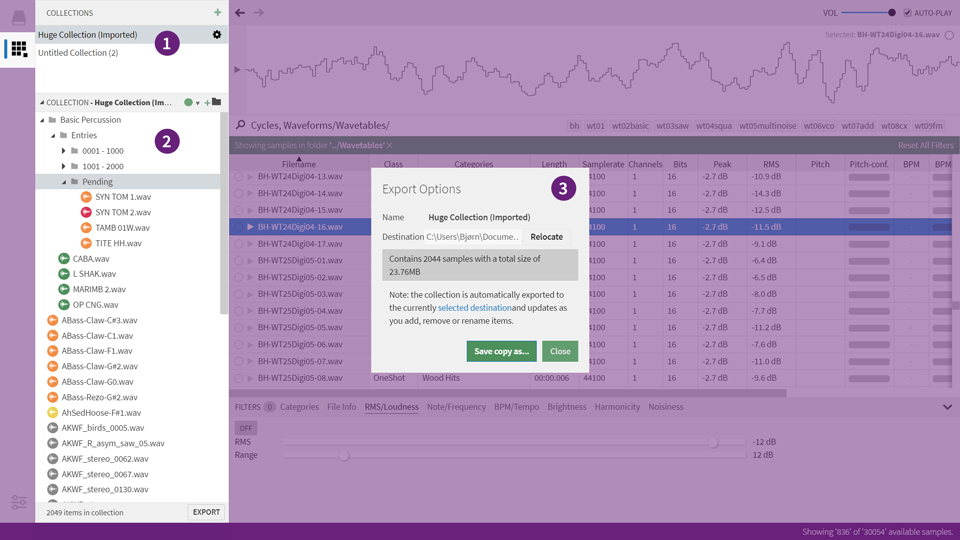
List of Projects (1), Tree widget (2) and Export dialog (3)
A Project is a place to store references to sounds. You can create as many projects as you like, freely organize sounds within each project and export them to a folder of your choice.
Projects also makes it easy to enforce a naming convention to items within the Project. For instance, you might want to tag all files with their BPM or Pitch information. The section on renaming explains how this can be achieved.
Adding Items
The easiest way to add an item to a project is to press the keyboard shortcut while browsing through some results. This will add the selected result(s), using the currently selected path in the currently selected project as the insertion point.
Alternatively, you can drag and drop the items manually:
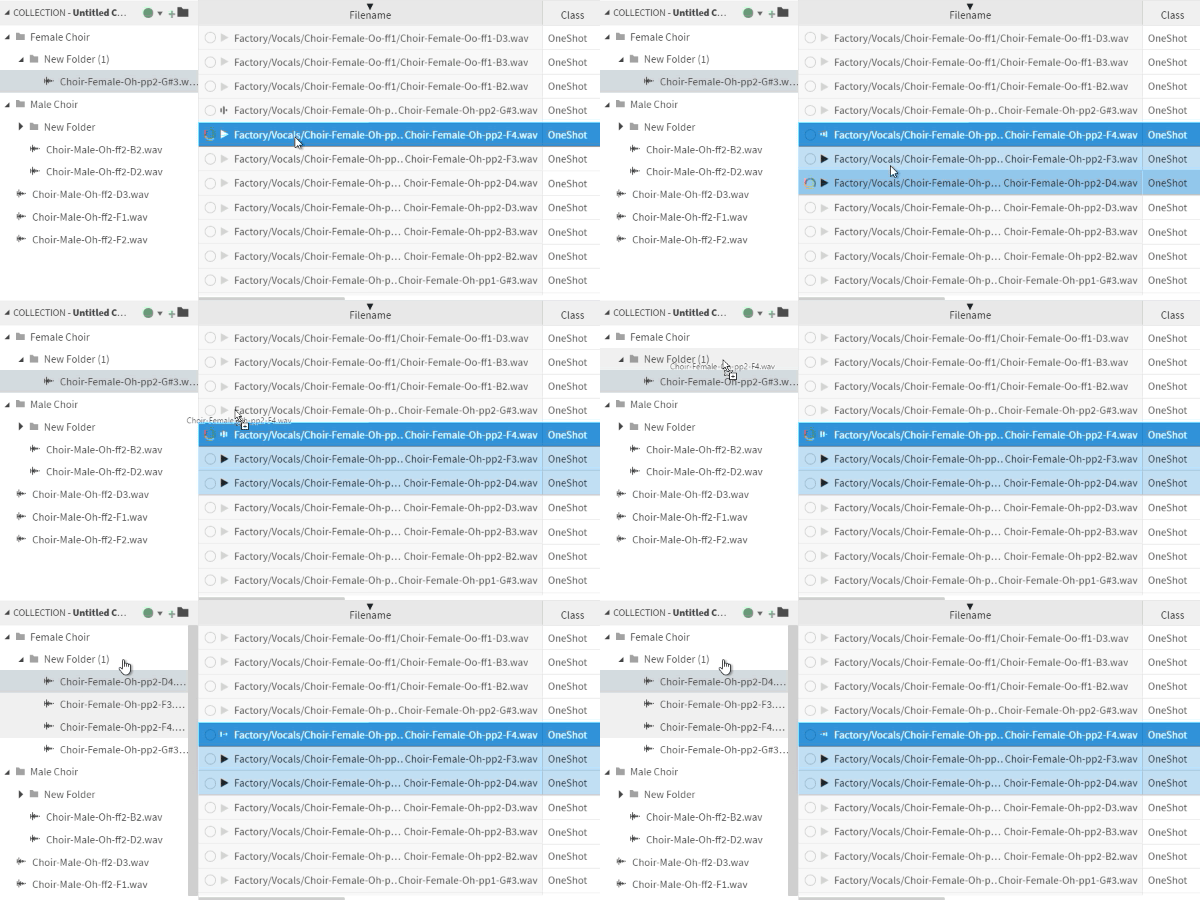
Using drag and drop to add items to a project
List of projects
- To select a project, click in the list (1)
- To re-arrange the list, use drag and drop.
- To view options for the project, press the “gear” symbol or right-click.
Creating a Project
By default, the application will start with an empty, default project, but you can always add a new one by pressing the relevant keyboard shortcut or hitting the green “+” at the top of the projects panel.
Organizing content
Once a project grows beyond a few items, it can become necessary to organize things a little more. Using the tree widget in lower part of the sidepanel, this is all accomplished quite easily:
- Create folders, delete, rename and assign colors to items
- Multi-select (hold shift key while selecting, etc.)
- Re-arrange items via drag and drop, or by using the clipboard (copy/paste).
Renaming items
When you add an item to a Project, you are able to provide an alternative name for it without modifying the original/source file.
If you click the checkbox Advanced Renaming, the rename dialog will expand and allow you to embed all sorts of information into the names of your files. Advanced renaming is a big subject with its own dedicated page.
Assigning Colors
Any item can be assigned to one of the seven available colors, but it’s up to you to decide the meaning. For now, the colors exist merely as a way to visually distinguish between files.
Options Dialog
To bring up the Options dialog, press the “gear” symbol or right-click (1), or press the “Options” button in the lower-right corner of the Tree (2).
Auto-Export
Enable auto-export to automatically export the Project to a folder of your choice, every time the contents have changed.
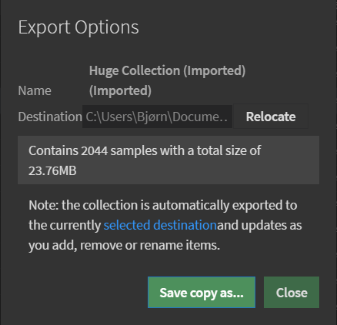
When you enable Auto-Export, the contents of the project will be exported to a folder of your choice. This folder, by default, is located in User Documents > Sononym.
If you want to use a different folder, click “Relocate” on the right side of the Target Folder. This will launch a file dialog asking you to pick a different folder - and asking you to confirm the action. Once you click OK, the project is moved to the new location. In other words, it’s not necessary to move the collection folder using Finder/Explorer/Etc.
Export JSON only
If you don’t want to include any samples when exporting, enable this checkbox. The option mostly makes sense when you are using export to synchronize a project with another machine that already has the necessary libraries loaded and ready.
Exporting
A project is either exported automatically or manually -
- Automatic Export: please see Auto-Export above.
- Manual Export: either bring up the Options Dialog and hit ‘Export’, choose File Menu > Export Project or press Cmd/Ctrl+E
Importing
A project can be imported by choosing “Import Project” from the File menu. This will open a file dialog, expecting you to select a file named project.json*. The imported project will appear in the list of projects, and should be ready to use.
If the project is found to contain file references that cannot be resolved - for example, due to missing libraries - a dialog might appear that allows you to “connect” the missing libraries. Simply look at the path, and choose the appropriate library (the application will pre-fill the dialog with educated guesses).
Synchronizing
This feature was introduced in v1.6.12
If you’re using multiple computers, or you are a working in a team setting, you are probably already synchronizing your samples in one way or another. Sononym Projects can be synchronized too, and the way it works is quite flexible.
Getting started
To use this feature, your project needs to point to a export folder/target.
- If you imported the project, you’re good to go.
- If you created the project, but never exported it, please export it somewhere.
- Verify by right-clicking the project. If you can “Reveal” the folder, you have an export target.
Also, it’s a good idea to have the libraries that you are using loaded & ready on all your machines - Sononym will then be able to connect files inside the project with your active libraries. See also “connecting libraries” just above .
Integrating external changes
Once you have defined an export target, the application will begin to monitor the file called project.json for changes.
If the export target has been modified, a little “refresh” icon will appear on the right-hand side.
At this point, auto-export is essentially disabled.
You will now have to integrate the changes into your local version. To do this, click the icon. This will show a summary of the changes: perhaps a few assets have been added, and some modified.
You can now choose to accept the changes (merge them into your project) or to do nothing.
Resolving conflicts
If you accept the changes, the application might tell you that there is a conflict and ask you to resolve it.
In practical terms, conflicts are resolved by going through a list of changes. The application will show the exact file and/or property that has been changed, and ask you to decide which of the change you want to keep.
But how would a conflict even happen in the first place? It’s quite simple. Imagine that your export target is located on a cloud drive which is synchronized with all your computers. Initially, you might be working on your desktop machine, making changes to your project. Later, you switch to your laptop (where you happen to have another copy of Sononym running), and decide to make some changes to the same project, and modify the very assets you also changed on the desktop.
In this case, there’s a conflict since you made changes to the same assets - the app can’t reconcile such changes. And to avoid potential loss of data, it instead asks you what to do.
Two things worth noticing:
- The “refresh” icon would have shown up as you switched to the laptop, and integrating the changes would have avoided the conflict.
- Modifying a project on two different machines isn’t necessary creating a conflict in itself. Most changes are able to be integrated automatically, using a 3-way merge algorithm.